True brotherhood is care for the physical wellbeing of our fellow man. The fight against poverty is part of this. But priority is the care for the body.
Parable of The Good Samaritan
Behold, a certain lawyer stood up and tested him, saying, “Teacher, what shall I do to inherit eternal life?”
He said to him, “What is written in the law? How do you read it?”
He answered, “You shall love the Lord your God with all your heart, with all your soul, with all your strength, with all your mind, and your neighbour as yourself.”
He said to him, “You have answered correctly. Do this, and you will live.”
But he, desiring to justify himself, asked Jesus, “Who is my neighbour?”
Jesus replies with a story:
Jesus answered, “A certain man was going down from Jerusalem to Jericho, and he fell among robbers, who both stripped him and beat him, and departed, leaving him half dead. By chance a certain priest was going down that way. When he saw him, he passed by on the other side. In the same way a Levite also, when he came to the place, and saw him, passed by on the other side. But a certain Samaritan, as he travelled, came where he was. When he saw him, he was moved with compassion, came to him, and bound up his wounds, pouring on oil and wine. He set him on his own animal, and brought him to an inn, and took care of him. On the next day, when he departed, he took out two denarii, and gave them to the host, and said to him, ‘Take care of him. Whatever you spend beyond that, I will repay you when I return.’ Now which of these three do you think seemed to be a neighbour to him who fell among the robbers?”
He said, “He who showed mercy on him.”
Then Jesus said to him, “Go and do likewise.” — Luke 10:25–29
In World War I Rudolf Steiner was asked to give advice about the nursing of the wounded. He gave a course which became known as the ‘Samaritan course’. In this course he gave an aphorism that expresses what is the main issue in nursing. This aphorism was also spoken in the lecture of 13th September 1914, in Munich. Here Steiner speaks on the one hand about coherence with the spirit of the nation – who works divisively in times of war – but at the other hand he speaks about the all-embracing power of Christ, that unifies people across the different nations, beginning in the relationship between one person and another.
| So lang du den Schmerz erfühlest, Der mich meidet, Ist Christus unerkannt Im Weltenwesen wirkend; Denn schwach nur bleibt der Geist, Wenn er allein im eignen Leibe Des Leidesfühlens mächtig ist. |
As long as only you feel the pain That avoids me, Christ is unknown Working in the being of the world; For weak remains the spirit If he is only capable of feeling The anguish in his own body. |
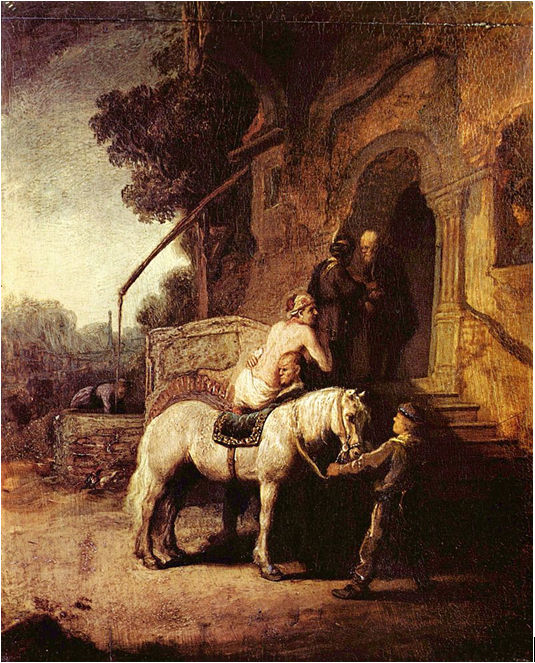
The good Samaritan by Rembrandt van RijnThe Good Samaritan by Mieke Mosmuller