The Memory is not a File

Yes, there are reactions to the fact that I speak the anthroposophical videos in German. And of course, it would be quite simple for me to also speak this in my mother tongue. But you must imagine that for years we have given many, many seminars and lectures in the German-speaking area. And that, of course, there are also many people who were there. And yes, actually, in the first place, I speak for these people. And back then, of course, I was never able to speak in Dutch, because they would not have understood it. Because when one is live somewhere, there are no subtitles. So I persist. I continue with the German language, although it may not always be perfect or not perfect at all. That should not matter. I try to do it as well as possible.
Hotel Corona
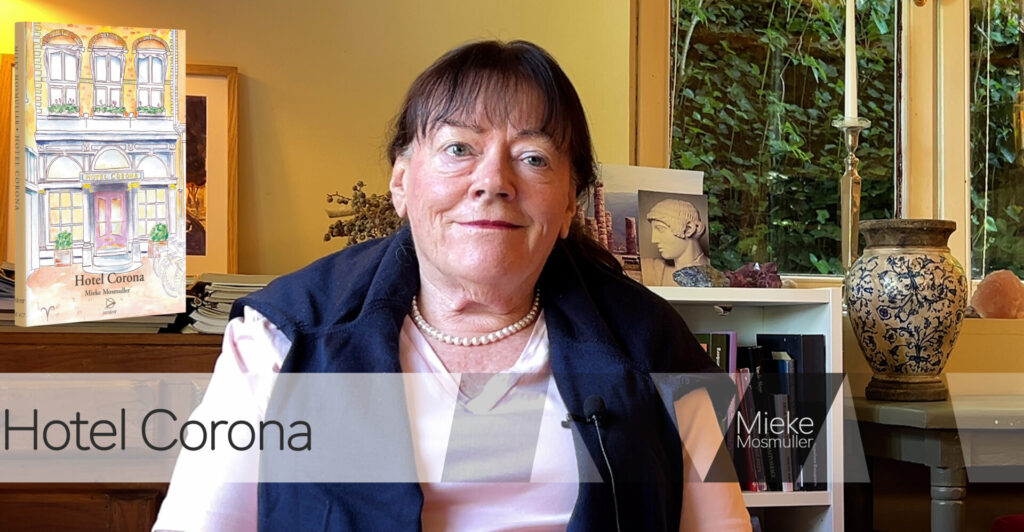
I wanted to present my new book today. It was published more than a week ago, but actually written much earlier. I will try to say something around it. Through the meditative study of anthroposophy, I discovered that every human being stands in the world from a certain worldview. That, of course, has a background. I won’t go into that. But it is a fact that we all look at ourselves and what happens in the world from a certain perspective. And those are twelve different directions, which are also connected with the zodiac. They are known, mostly well-known, philosophical, spiritual worldviews. For example, there is materialism, and directly opposite to that, there is spiritualism.
Now, it happened that I—this was around the turn of the century—received an impulse, actually, to try and write novels from the perspective of those twelve worldviews. Well yes, that’s not something you do from one day to the next. And now, 25 years have passed. And I’ve written eight so far.
Karma and Reincarnation
Karma and reincarnation, that is a main theme in anthroposophy, and this theme actually brings back into modern times what in antiquity was still a matter of course—back into the West, I would like to say, because in the East, of course, this thought was always already there. But in the West, in Western views, it is naturally still something new—not entirely, but quite a bit. And the wonderful thing about Rudolf Steiner is that he does not ask us to simply believe that the human being is a reincarnating being with karma, but that he made the effort to try to clothe that which he himself perceived in his clairvoyant consciousness as a matter of course, as a truth, very clearly in thoughts for us, so that we do not have to believe, but so that we can think along with thoughts that it must indeed be so.
Spring and the Calender of the Soul

Today, I wanted to return once more to the Calendar of the Soul by Rudolf Steiner. Written in 1912, maybe also still in 1913. These are verses for each week, in which you—if you work with them—can experience how the relationship between you as a human being, nature, the cosmos, and the seasons changes throughout the year. That is something very special. Initially, you may not notice it. I could imagine that at first these verses seem somewhat complicated and that, after a year of working with them each week, you still feel like you haven’t fully grasped them. Perhaps here and there you’ve noticed some connection between what you’re meditating on and what is happening in nature and the cosmos.
Catholic Faith and Anthroposophical Knowing

The death of the Pope has prompted me once again to ask myself: what actually is the difference between Catholic faith and anthroposophy? When I put it like that, then of course the first difference is that anthroposophy is not a faith and also not a religion. So what is the point, really, of comparing them? I also do not want to compare them, but of course there are many people who originally were in the Catholic Church, perhaps also simply remain in it, do not have themselves removed from its records, and then nevertheless find anthroposophy and prefer that. And then the question arises: what actually is the difference? I believe that in the time of Rudolf Steiner, anthroposophy was forbidden for Catholics. I do not know how far that went, but it was not permitted to feel oneself Catholic and at the same time to be an anthroposophist. That must surely sometimes have been the case, but officially anthroposophy, of course, was not considered something divine, people thought. The great, greatest difference is that in anthroposophy the knowing of karma and reincarnation has come. And that is still entirely rejected by the Christian churches. Although in the New Testament there are indeed passages where one actually must read that the idea was alive at the time. For there is the passage where John the Baptist, when asked whether he was Elijah, says: no, I am not. How could he be Elijah, if there were no reincarnation? That will undoubtedly be answerable by theologians, what that then is supposed to mean. But one can also of course read it in such a way that the question was: are you the reincarnated Elijah?
The Pope and Francis

On Easter Monday, the Pope died. I found it an interesting remark by Putin who said: I don’t know how it is with the Catholics, but with us it is such that when someone dies at Easter, that is a sign that it was a significant life. I then thought of Toon Hermans who died on Good Friday. That undoubtedly is also a sign. So I wanted to dedicate this video to, yes I don’t want to say the Pope, but to that which is also evoked by his death. Because it is, of course, no matter how you look at it, the death of a world leader. And that gave me reason to reflect again on: how do you actually relate to it, to the existence and meaning of the Pope.
The Rose Cross

‘He already sees himself close before the silent place, which fills his spirit with peace and hope. And on the arch of the closed gate, he beholds a mysterious image. He stands and contemplates and whispers soft words of devotion that well up in his heart. He stands and contemplates. What does that mean? The sun sings and the ringing fades away. He sees the sign magnificently erected, which stands as comfort and hope for the whole world, to which many thousands of spirits have pledged themselves, to which many thousands of hearts have fervently pleaded, which destroys the power of bitter death, which waves in many a victory banner. A refreshing spring penetrates the weary limbs. He sees the cross and casts his eyes downward. He newly feels what salvation has sprung forth there. He feels the faith of half a world. But he is penetrated by an entirely new meaning, as the image now appears before his eyes. There stands the cross, tightly entwined with roses. Who has added roses to the cross?’
Good Friday and Easter

Isn’t it remarkable that the Easter celebration—and, naturally, also Ascension and Pentecost, which are connected to it—are still determined, their timing, in connection with the cosmos? That is truly something extraordinary for the abstract mind. That it hasn’t already been said long ago: well, let’s do it like Christmas. Easter was, as primordial Easter, on the weekend of April 5. So, let’s just fix it there and do it that way every year. No, cosmic phenomena are taken into account. Namely, Easter falls on the first Sunday after the first full moon after the vernal equinox. And that means that—we are, of course, accustomed to this—we cannot say, Easter is always on the weekend of April 5. Then you might also have to say, we won’t do the weekend, but we’ll fix the dates.
Rudolf Steiner, the Initiate

Now it is more than a week after the hundredth anniversary of Rudolf Steiner’s death.And what struck me – I haven’t watched that much, but I think you watch what you are meant to watch – what struck me is that there is a tendency – and I of course already knew this tendency, but it became very clear again – that there is a tendency to view Rudolf Steiner as a brilliant person. As someone who, at the beginning of the twentieth century, brought many new things, also many valuable things, that he was truly incredibly talented. But, yes, not an initiate by virtue of a holy soul. I didn’t really notice that anyone wants to represent that.
People want a Rudolf Steiner whom they can criticize, just like all the great scientists and philosophers and artists can be criticized.
Political Dementia

Yes, of course we can’t avoid talking about politics. Even though I’m actually not that interested in it, but you kind of have to. I’ve always found politics to be an exceptionally difficult field, I’ve said that before. Because you’re dealing with extremes, and even when you have a centrist party, that in itself is also still extreme. And you actually can’t, at least I can’t, find a party of which you say, well, that really represents most of what I also think. I suppose everyone has that, and of course people have very different views.But in our time it’s become very difficult to still take politics seriously. I remember the time of Van Agt and Den Uyl.