The Soul

It seems that I have to explain every time why I, as a Dutch woman, speak German. Yes, of course I can’t do that every time. And I know all too well that I am a Dutch woman who tries to speak German. But I continue doing it this way, because I have many German-speaking friends who, over the course of years, have more or less walked the path with me. And when I really speak about anthroposophy, as I do in these videos, then I speak German. And my German, of course, is not completely bad either. We continue with the explanations of Rudolf Steiner in his book Theosophy about reincarnation and karma.
Thoughts Have No Power

Last time, I made a case for the idea that thoughts have power. And today I would like to contradict that. I believe it’s generally healthy to contradict oneself regularly, but this time it is also necessary. I’m also responding to several reactions I received, including via email, which I always find very interesting and which truly help to shape the subject further. So I thank everyone sincerely for the responses that keep coming in – I always read them.
Thoughts have no power. Thoughts are reflections of something that once was real, but now more or less dissolve into an illusory reflection.
The Importance of Repetition

We follow the chapter “Reincarnation and Karma” in the book Theosophy by Rudolf Steiner, in order to get an impression of how one can, with thinking alone, obtain a very great certainty about this phenomenon of reincarnation and karma. First, Rudolf Steiner had posed the question whether it could perhaps be that, just as we have a memory within ourselves, the world too has a memory — a memory for the deeds we perform upon it.
Do Thoughts have Power?

The question is: Do thoughts have power? Of course, we try to think along with world events. And the question is whether that also changes anything in world affairs when we do so. I believe that when you think along with ordinary, more associative thinking, it doesn’t have much effect. Everyday thoughts—you can sort of just pass right through them—they have little to no power. At least, no power that means anything in world events. But on the other hand, it is known—and this is known even in not particularly spiritual circles—that when you really want something with your thoughts, it does generate a force that helps make what you want happen.
The ancestors of the person

Let us continue with karma and reincarnation as Rudolf Steiner made it understandable for us in his book Theosophy.What is special about it is that he always tried to make clear that the spiritual can really be followed by thinking, that one can understand it, that one does not need to be clairvoyant for it, but that – as he sometimes calls it – the healthy human intellect is there for that purpose and is spiritually sufficient to understand a spiritual science that has been perceived by a clairvoyant. And he actually gives, in the book Theosophy, and as an example in the chapter on reincarnation and karma – there he bears witness to the fact that it is so. What one actually notices, if one reads very concentratedly and precisely what he has written, then one notices that thinking shifts to another level. Although it remains intellectual thinking, it quietly becomes something else. And if this shift does not take place – yes, then one reads in such a way – then one can, as they say, read diagonally – like: one, two, three, hop – then one reads it superficially, and that which Rudolf Steiner writes is not to be taken as proof of the reality of reincarnation and karma. But if one takes part in this slight shift, then in the course of the text it becomes clear – it really seems to shine through – this spiritual reality; it becomes clear that here, through these words, through these concepts, through this sequence of thoughts, it is proven that the human being is a reincarnating being. And in the previous two videos on this topic, I first described the beginning – that Rudolf Steiner poses as a kind of question: whether it might not be possible that the world, too, has a memory. That not only human beings are the ones who can remember all sorts of things, but that also the world, which we change through our actions, that this world has a memory. And that at some point the facts will reappear and must be balanced out. That is a question – he does not immediately answer it with “yes,” but it is a wonderful idea. And one feels, if one reads it in the way I meant, then one feels that one enters another mode of thinking when one wants to regard such a question as a possibility. For then one no longer has only that which is known to us – our own memory capacity – but one imagines that in the world, which is for us more or less spiritless, soulless, that in this world there could be something like something soulful, something spiritual, that could remember our deeds.
Democracy

In recent weeks we have experienced the fall of the cabinet in the Netherlands. I have said before, I cannot connect myself to a party. That just doesn’t work, because I see something in all parties, but I also see a lot in all parties with which I totally disagree. So you might almost say: start your own party, but that is completely out of the question. But what then at least very clearly stands out is the use of the word democracy. And I must say that it has increasingly started to irritate me how that word is used, with what kind of conduct and a certain way of being very sure that precisely that party which is speaking, knows what the true democracy is.
The Memory is not a File

Yes, there are reactions to the fact that I speak the anthroposophical videos in German. And of course, it would be quite simple for me to also speak this in my mother tongue. But you must imagine that for years we have given many, many seminars and lectures in the German-speaking area. And that, of course, there are also many people who were there. And yes, actually, in the first place, I speak for these people. And back then, of course, I was never able to speak in Dutch, because they would not have understood it. Because when one is live somewhere, there are no subtitles. So I persist. I continue with the German language, although it may not always be perfect or not perfect at all. That should not matter. I try to do it as well as possible.
Hotel Corona
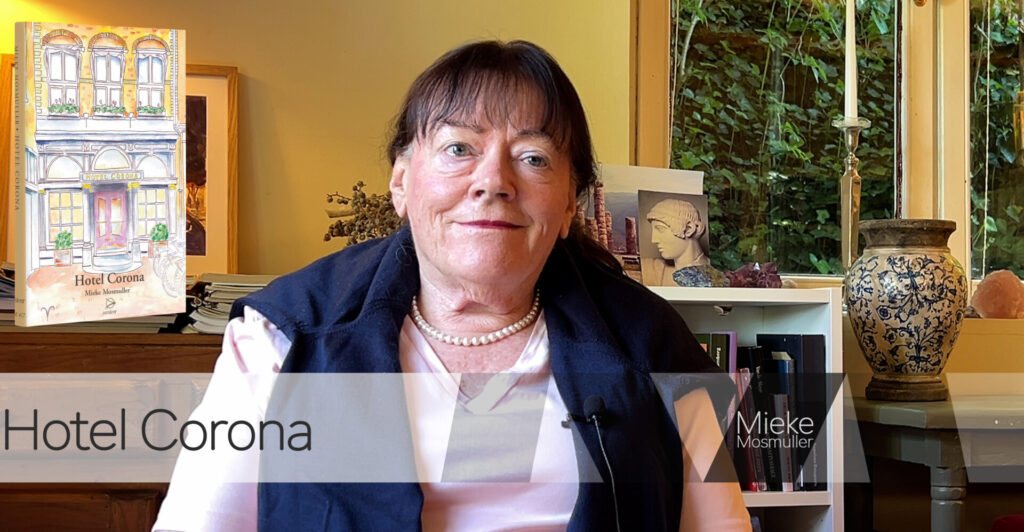
I wanted to present my new book today. It was published more than a week ago, but actually written much earlier. I will try to say something around it. Through the meditative study of anthroposophy, I discovered that every human being stands in the world from a certain worldview. That, of course, has a background. I won’t go into that. But it is a fact that we all look at ourselves and what happens in the world from a certain perspective. And those are twelve different directions, which are also connected with the zodiac. They are known, mostly well-known, philosophical, spiritual worldviews. For example, there is materialism, and directly opposite to that, there is spiritualism.
Now, it happened that I—this was around the turn of the century—received an impulse, actually, to try and write novels from the perspective of those twelve worldviews. Well yes, that’s not something you do from one day to the next. And now, 25 years have passed. And I’ve written eight so far.
Karma and Reincarnation
Karma and reincarnation, that is a main theme in anthroposophy, and this theme actually brings back into modern times what in antiquity was still a matter of course—back into the West, I would like to say, because in the East, of course, this thought was always already there. But in the West, in Western views, it is naturally still something new—not entirely, but quite a bit. And the wonderful thing about Rudolf Steiner is that he does not ask us to simply believe that the human being is a reincarnating being with karma, but that he made the effort to try to clothe that which he himself perceived in his clairvoyant consciousness as a matter of course, as a truth, very clearly in thoughts for us, so that we do not have to believe, but so that we can think along with thoughts that it must indeed be so.
Spring and the Calender of the Soul

Today, I wanted to return once more to the Calendar of the Soul by Rudolf Steiner. Written in 1912, maybe also still in 1913. These are verses for each week, in which you—if you work with them—can experience how the relationship between you as a human being, nature, the cosmos, and the seasons changes throughout the year. That is something very special. Initially, you may not notice it. I could imagine that at first these verses seem somewhat complicated and that, after a year of working with them each week, you still feel like you haven’t fully grasped them. Perhaps here and there you’ve noticed some connection between what you’re meditating on and what is happening in nature and the cosmos.